Part One
Katrice’s Story
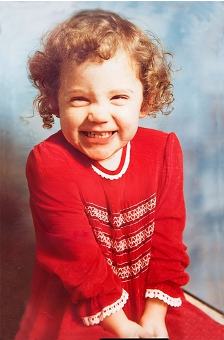
On 28 November 1981, Katrice Lee’s second birthday, the lively two-year-old, with hazel eyes and a smile that could brighten the gloomiest day, disappeared without a trace.
Sometime mid-morning that Saturday, her family, including the little girl, went shopping to a nearby British military supermarket, the NAAFI, in Schloß Neuhaus, near Paderborn in what was then West Germany. It was a day meant for celebration.
At the checkout, inside the crowded supermarket, Katrice's mother Sharon realised she had forgotten to pick up some crisps. She asked her sister Wendy to watch Katrice while she headed along an aisle to get the snacks. Seconds later Katrice toddled through the jam-packed supermarket to follow her mother. She couldn’t have gotten far, but when Sharon returned, Katrice was gone.
The NAAFI
If you have reached this website by scanning the QR code on the plaque dedicated to Katrice, you are standing at the former NAAFI where she disappeared.
More than four decades have passed. Despite searches, appeals and repeated investigations, what happened to Katrice remains unknown.
This is Katrice's and their story.
Family life
In 1981, Katrice’s father Ritchie, was posted from Bovington in Dorset to Paderborn garrison in what was then West Germany. A staff sergeant in the 15th/19th King’s Royal Hussars, at that point he had served for more than ten years. The Army was his life.
Ritchie and his wife Sharon had met at Fallingbostel, where she was working for the NAAFI and he was based at Wessex Barracks. They married in 1972 two years later, their first daughter Natasha, was born.
Around five years later, the family moved into a three-bedroomed flat at Am Wilhelmsberg, on the outskirts of Schloß Neuhaus. The privately owned flats were leased to the Army. They were known to everyone as ‘Legoland’.
Ritchie, his heavily pregnant wife Sharon and Natasha settled into their new home. A few months later, another daughter was born at the British Military Hospital in Rinteln, about an hour from Schloß Neuhaus – she was named Katrice.
As Sharon could not drive, she would wheel Katrice down to the NAAFI or the play park while Natasha was at school. Katrice quickly grew into a typical toddler: adorable, loveable, sometimes cantankerous and not afraid to use her teeth to make a point.
The girls loved each other. Natasha would arrive home on the school bus, sparking Katrice to launch into her favourite game of hide and seek. She was, like all young children, very bad at it and usually giggled behind the floor-length curtains with her toes peeking out below the hem.
Halfway through November 1981, Ritchie came home from a three-week military exercise to find two excited children waiting for him. He jumped in the bath and was joined by Natasha and Katrice, who perched on his leg. He bounced Katrice down into the water and she screamed.
She hated water, something Ritchie would bitterly try to explain later.
Katrice’s disappearance
The day started with much excitement. Katrice was too young to understand it was her birthday but knew it was going to be a special day as things were different. Daddy was home, and Mummy’s sister, Aunty Wendy, and her partner, Uncle Cliff, were coming over from Bielefeld, about 40km away.
That morning Katrice ran into her parents’ bedroom and bounced onto the bed. Ritchie remembers playing with her and making her laugh, one of his last memories of his little girl.
Wendy and Cliff arrived and a trip to the NAAFI for some last-minute birthday items was agreed. Natasha didn’t want to go shopping, so she and Cliff stayed at the flat.
Ritchie drove Sharon, Wendy and Katrice into Schloß Neuhaus. A bit of drizzle on a grey November day was not going to dampen anyone’s mood, least of all the Lee family, who had something to celebrate.
The NAAFI was a British military supermarket housed in the former stables of Schloß Neuhaus. Unlike most military facilities, it was outside the wire and served soldiers and their families from several bases around Paderborn.
The supermarket was a U-shaped building divided into food and non-food sections. Shoppers entered the food hall through a wooden partition and left through the tills. The entrance doors were sprung shut and had no handle on the inside, making it difficult for a small child to leave the store unaided.
The NAAFI was particularly busy that morning. Soldiers had recently returned from exercise and been paid, families were shopping ahead of Christmas, and an open day at the secondary school opposite added more vehicles to an already crowded car park.
Ritchie dropped the family off and circled the black cinder car park looking for a space. After about 15 minutes he parked and leant against the car, having a cigarette while watching the door.
Katrice disliked riding in the trolley, so Sharon carried her around the store while she and Wendy jostled with other shoppers in the narrow aisles. Eventually they joined one of the three queues for the tills.
Sharon remembered she had forgotten to pick up the crisps. She asked Wendy to look after Katrice while she headed along a dead-end aisle to grab a bag. Seconds later Katrice toddled off through the crowd to follow her mother. Sharon returned with the crisps to the till queue to find Wendy, a trolley and no Katrice.
Panic rising, she ran around the store calling her daughter’s name, certain she would be just around the next corner. With the realisation that Katrice was not in the store, she dashed back to the tills where she had seen a female Royal Military Police officer and asked her to call headquarters at Sennelager for help.
She remembers little after that.
No one saw the moment Katrice disappeared from the supermarket. What happened next remains unknown.
The first hours
Outside, Ritchie became aware something was wrong and pushed his way into the store. As he headed past the manager’s office, he saw Sharon inside, beside herself.
Wendy told him: “Katrice has gone missing.”
Ritchie grabbed every soldier he knew from his regiment who was in the store and they started searching.
It seemed beyond belief that Katrice could have left the supermarket. There was no handle on the shop side of the entrance door, and she could not have got out through the tills, which were blocked by shoppers. There were also people in the store who knew the Lees and families with young children casting watchful eyes around them.
Ritchie had been outside watching the entrance. It seemed inconceivable that a stray toddler could have wandered around for long, or that someone entering the shop would have let a tiny child leave unaccompanied.
With a search underway both inside and outside the store, Ritchie set off on foot in the hope of finding Katrice making her way home. He grabbed a photograph from the flat to show people and ran back by a different route.
Katrice was a distinctive-looking child with lots of curly light-brown hair, hazel eyes and a squint in her left eye which would have needed correcting when she was older.
On the day she vanished she was memorably dressed. She loved her red Wellington boots and was wearing them with a turquoise Mothercare duffel coat, a green and blue frilled tartan pinafore dress, white blouse and white tights.
By the time Ritchie returned to the NAAFI, the Royal Military Police had arrived, and the search was beginning to grow.
Memories of those first hours are blurred.
Natasha remembers her father returning to the flat. She was sitting on the floor, facing the sofa, playing with her Playmobil toys while Uncle Cliff watched a film.
She remembers being bundled into the family car and later sitting in a car park in Schloß Neuhaus. She was in the back between her aunt and mother. Sharon was distraught.
It started to grow dark.
The family eventually returned to the flat where they should have been celebrating a birthday. Sharon’s neighbour downstairs had baked a birthday cake. Jelly and ice cream were ready. Presents were wrapped. The birthday girl was missing…
Sharon was inconsolable. A neighbour later recalled driving with her to the medical centre at nearby Sennelager. On the way they passed groups of men and women linked together, searching the woods and calling Katrice’s name. Loudhailers could be heard and Katrice’s photograph was already on a noticeboard.
Sharon was given a sedative and went to bed. Wendy looked after Natasha.
Ritchie telephoned his father Andrew, in Hartlepool, to tell him that Katrice had gone missing. His father had only seen his granddaughter once. Stunned and unable to cope with the news, he put the telephone down on his son.
The following day Natasha went to stay with her best friend Heather and her parents in the flat below. They tried to keep some sense of normality in her life while the search for her sister continued.
Natasha remembers returning upstairs to see her parents and being shocked by the transformation. Her home, usually light and bright, was dark and sombre.
Her little sister was still missing.
The Search for Katrice
There were immediately two theories about what had happened to Katrice. The police believed she had wandered from the NAAFI and drowned. Her family were convinced she was alive and had been taken.
The early investigation was led by the West German police, with the Army providing the manpower required for the search and support. It was an unusual situation. Katrice had disappeared from a British military supermarket in a West German town, and responsibility was divided between the German authorities and the Royal Military Police.
From the outset, the search concentrated heavily on the River Lippe. The theory was that Katrice had somehow left the supermarket unnoticed, crossed the crowded car park and made her way about 100 metres towards the fast-flowing river before falling into the water. Her family struggled to accept this. Katrice was only two years old. The river could not be seen from the NAAFI and, to reach it, she would have had to cross the car park and negotiate hedges and undergrowth. She also hated water.
While the family believed every possibility should be considered, the assumption that Katrice had drowned shaped much of the early response.
Soldiers from the Paderborn garrison were recalled to help with the search. Hundreds of men and women combed the surrounding area, woods and riverbanks. Some stood waist-deep in the water using grappling hooks, while divers from the Royal Engineers searched the rivers, lake and drainage ditches in almost zero visibility. A helicopter was deployed, the search area was broadened and the moat surrounding Schloß Neuhaus was drained.
No trace of Katrice was found.
For the Lee family, however, another fear was growing: if Katrice had been abducted, valuable time was being lost.
The supermarket had not been secured and many potential witnesses were not interviewed immediately. Border staff were not alerted for 48 hours and no roadblock was established at the NAAFI. Some shop staff would not be interviewed until weeks later.
At the time, the nearby Autobahn offered quick access away from Paderborn and towards international borders. With British military families regularly travelling between West Germany and the UK, the Lees feared that whoever had taken Katrice could already have been far away.
There was also very little media coverage in the first weeks. The message being given publicly was that a little girl was believed to have wandered away and drowned. There was no major appeal asking the public to help find an abducted child.
As the days became weeks, the search continued. The River Lippe and surrounding waterways were searched repeatedly. The Lippesee was examined and the water level was lowered to allow further searches.
Nothing belonging to Katrice was found.
The Lee family became increasingly frustrated. They wanted the possibility that their daughter had been taken to be treated seriously and they wanted a wider public appeal.
Help eventually came from outside the investigation.
After Katrice’s aunt Wendy wrote to the Mayor of Paderborn, local journalist Horst Pieper became involved and helped organise a press conference. Friends and supporters formed a committee, raised money for a reward and began generating publicity. For the first time, another possibility was being discussed publicly: Katrice might not be in the river. She might have been abducted.
The publicity brought new information and possible sightings, but also false hope. Leads were followed, children resembling Katrice were reported in different places, and each possibility had to be considered. None led to her.
By the autumn of 1982, the German investigation was being brought to a close. But the Lee family were not prepared to let the search end.
They would spend the years that followed campaigning, appealing, writing to politicians and pressing the authorities to look again at what had happened inside the NAAFI on 28 November 1981.
A family’s search for answers
Within weeks of her disappearance, Ritchie and Sharon were offered a relocation to Canada. They refused. While they believed there was a chance their daughter might still be alive, they were not prepared to leave Germany. They continued to press for more to be done and for the possibility that Katrice had been abducted to be taken seriously.
As publicity grew, so did public support. Thousands signed petitions, appeals appeared in newspapers and on television, and reconstructions of Katrice’s disappearance were broadcast in Germany and Britain.
The publicity brought repeated hope but also disappointment. Possible sightings were reported and people came forward believing they had seen Katrice. Each time the family had to confront the possibility that their daughter had been found.
None of the sightings led to her.
As the years passed and investigations became inactive, it increasingly fell to the family to keep Katrice’s name in the public consciousness.
They wrote letters, spoke to journalists and lobbied politicians. Prime ministers came and went. MPs were approached and questions were asked about the way the original investigation had been conducted.
Ritchie was even given a dressing down by the Army after writing directly to Prime Minister Margaret Thatcher to challenge official information about the scale of the search.
But the family carried on.
In 2000, advances in investigative techniques led the Royal Military Police to look again at Katrice’s disappearance. New lines of inquiry were emerged and the following year blood samples were taken from the Lee family in the hope that advances in DNA technology might provide fresh leads.
By 2003, the investigation had again gone cold.
The growth of the internet and social media gave the family something they had not possessed in 1981: a way of speaking directly to the public. Natasha established an online presence dedicated to the search for her sister, helping to keep Katrice’s face and story visible. The family also continued trying to gain access to information held about the original investigation. For them, the unanswered questions were not only about what had happened to Katrice, but whether opportunities to find her had been missed.
In November 2012, more than 30 years after Katrice disappeared, her case was raised in the House of Commons.
Hartlepool MP Iain Wright described the original investigation as “botched from the very start” and highlighted failures in the way evidence, witnesses and possible lines of inquiry had been handled.
Gosport MP Caroline Dinenage was equally critical, saying the tragedy of Katrice’s disappearance had been “cruelly compounded” by failings in the investigation.
For Sharon, Ritchie and Natasha, the acknowledgement mattered, but it did not answer the question they had been asking since their daughter’s disappearance. Where was Katrice?
A new investigation, Operation Bute, had begun earlier that year. Original evidence was reconsidered, witnesses were traced and re-interviewed and modern investigative techniques were applied to a case that was already more than three decades old. There would be new appeals, new age-progressed images, a previously unseen photofit and in 2018, another major search in Paderborn.
No trace of Katrice was found.
In 2020, active investigation under Operation Bute ceased, with the case moving to a reactive state pending new evidence.
But the family’s search did not.
On 31 May 2024, frustrated by the lack of answers, Ritchie, accompanied by supporters, travelled to Downing Street and returned his military medals.
More than four decades after Katrice disappeared, her family are still asking the same question.
What happened to Katrice?
Part Two
The Investigation
The investigation into the disappearance of Katrice Lee has been marked by missed opportunities, lost time and acknowledged failings. For decades her family have questioned whether decisions made in the hours, days and years after she disappeared prevented the truth from being discovered.
The original investigation
From the outset, the investigation concentrated heavily on one theory: that Katrice had somehow left the NAAFI unnoticed and fallen into the nearby River Lippe. Her family believed she had been abducted.
The drowning theory required a two-year-old child to leave a crowded supermarket unseen, cross a busy car park and make her way towards a river she could not see, negotiating hedges and undergrowth before reaching the water. Katrice also hated water.
Despite the family's concerns, the possibility of abduction did not receive the same attention during the crucial early stages of the investigation. The consequences were significant.
The NAAFI was not immediately secured and continued trading. Potential witnesses were allowed to leave. Staff working on the shop floor and tills were not interviewed until six weeks after Katrice disappeared. A sergeant-major who was close to the family and later considered a key witness was not interviewed as such until 31 years later. No roadblock was established outside the NAAFI. Border staff were not alerted for 48 hours. The nearby Autobahn provided rapid access away from Paderborn and towards international borders. If Katrice had been abducted, the first hours were critical.
The physical search itself was extensive. Soldiers, military police, German police and volunteers searched the surrounding area. Divers searched the Lippe, Lippesee and drainage ditches. A helicopter was deployed and the moat surrounding Schloß Neuhaus was drained.
No trace of Katrice was found.
In 2012, Hartlepool MP Iain Wright told the House of Commons that the investigation had been “botched from the very start”, arguing that valuable time, resources and evidence had been wasted or lost.
Gosport MP Caroline Dinenage was equally critical, saying the tragedy of Katrice's disappearance had been compounded by the “incompetence and insensitivity” of the Royal Military Police.
These were no longer simply accusations being made by a grieving family.
Later that year, the Provost Marshal (Army) acknowledged that previous investigations had been flawed, and the Royal Military Police apologised to the Lee family.
A distinctive clue overlooked
Katrice had a distinctive squint, or turn, in her left eye.
Her family told investigators that the condition would require corrective surgery when she was older. If Katrice had been abducted and raised by another family, they believed this provided a potentially important way of finding her.
The information was not pursued.
According to evidence later given in Parliament, when the family asked about the line of inquiry six months later, the officer in charge denied knowledge of it and told them it was a “figment of the Lees’ imagination”.
No attempt appears to have been made to use Interpol to identify children undergoing the relevant corrective procedures when Katrice would have reached the appropriate age. Another potential opportunity had passed.
The investigation reopens
By the turn of the millennium, advances in investigative techniques prompted another look at the case.
In February 2000, following a review by the National Crime Faculty, the Royal Military Police reopened inquiries. New lines of investigation were followed, and a former soldier was arrested and questioned before being released.
In February 2001, police and Army investigators took blood samples from members of the Lee family. The intention was to use advances in DNA technology to generate new leads, and the samples were supposed to be placed on an Interpol database.
The investigation was suspended again in 2003.
Almost a decade later, the family discovered another troubling problem.
The missing DNA
When the investigation was reopened again in 2012, the Lee family were asked to provide blood samples for a second time. They wanted to know why. More than ten years earlier, they had already provided samples specifically so that their DNA could be used to help identify Katrice and placed on an Interpol database. No explanation was given for why new samples were required. The family's MP raised the issue in Parliament. At that point, Ritchie did not know whether the original samples had been lost, degraded, used, or ever checked against criminal evidence or hospital records.
More than a decade after giving their DNA to investigators, the family could not even establish what had happened to it.
They provided new samples. Another eleven years had been lost.
Operation Bute
In January 2012, the Royal Military Police began a new investigation into Katrice's disappearance under the name Operation Bute. This time investigators went back to first principles.
The team included military police and civilian investigators trained to national policing standards. They had access to the Home Office Large Major Enquiry System, HOLMES 2, and sought assistance from specialist organisations including the Serious Organised Crime Agency, child-abduction specialists and the FBI.
Investigators faced an enormous task.
Around 2,000 people were believed to have visited the NAAFI on the day Katrice disappeared. Operation Bute attempted to trace and re-interview them more than 30 years later.
Memories had faded. Some witnesses had died. The NAAFI itself had closed. Many of those difficulties were unavoidable after three decades.
The question for the family was how many of them would have been avoidable had the investigation been conducted differently in 1981.
The photofit
During an appeal on BBC Crimewatch, investigators released a photofit of a man they wanted to identify.
A witness had reported seeing a man at the NAAFI carrying a young child fitting Katrice's description towards a green saloon car.
Ritchie saw the image for the first time when it appeared on television in 2017. It had been produced shortly after Katrice vanished but not released publicly until 35 years later.
The 2018 search
In spring 2018, Operation Bute announced a major forensic search of the bank of the River Alme at Paderborner Strasse, approximately two and a half kilometres from the former NAAFI. The location had been identified following a reanalysis of the evidence. Military personnel and civilian forensic specialists excavated the riverbank looking for evidence that might finally establish what happened to Katrice.
The search also renewed the appeal to identify the man in the photofit and the green saloon car. Investigators also released a new age-progressed image showing how Katrice might look as an adult and again drew attention to the distinctive condition affecting her left eye.
The excavation found no evidence establishing what had happened to Katrice, and the site was eventually ruled out.
A reactive investigation
By 2020, Operation Bute had exhausted the active lines of inquiry available to investigators. Active investigation ceased and the case moved to a reactive state, meaning further investigation would depend upon new information or evidence coming to light.
The case was subsequently transferred to the Defence Serious Crime Command.
What remains unanswered?
More than four decades after Katrice disappeared, fundamental questions about the investigation remain unanswered.
Why was the NAAFI not immediately secured, allowing potential witnesses to leave without being identified or questioned?
Why were some staff not interviewed until six weeks later, while other potentially important witnesses were not interviewed for decades?
Why were border authorities not alerted for 48 hours, and why was no roadblock established when the possibility of abduction could not be ruled out?
Why was Katrice’s distinctive eye condition not pursued as a potential means of identifying her?
What happened to the DNA samples provided by the Lee family in 2001, and why were they asked to provide new samples more than a decade later?
Perhaps most significantly, why was a photofit produced shortly after Katrice disappeared — based on a witness account of a man carrying a child fitting her description towards a green saloon car — not released publicly until more than 35 years later?
None of these failures proves that Katrice would have been found had things been done differently. But each represents an opportunity that can never be recovered.
For Katrice’s family, one question remains above all others:
What happened to Katrice?
Part Three
How to Help
Still Missing
Katrice Lee disappeared on 28 November 1981, her second birthday, from the NAAFI at Schloß Neuhaus, Germany. She has never been found.
No one has been able to establish what happened to her that Saturday morning.
Since her disappearance, the supermarket has closed and the British military community that once surrounded Paderborn has largely gone. Many of those who were there in 1981 have grown old. Some have died.
Katrice would now be in her forties. For Sharon, Ritchie and Natasha however, the passage of time has never changed the most important fact: she is still missing.
They have lived with unanswered questions for more than four decades. They have campaigned, appealed to governments, challenged the authorities and repeatedly asked anyone with information to come forward. They have never stopped looking for her.
Can you help?
Somebody may still know what happened inside or around the NAAFI on 28 November 1981. Someone may remember something they saw or heard but at the time, did not think it might be important. Others may have information they have never shared.
It is not too late.
If you have any information about the disappearance of Katrice Lee, however insignificant you think it may be, please come forward.
Who to contact
You can provide information to Operation Bute, the Defence Serious Crime Unit’s Investigation into Katrice's case, by contacting them through the following channels:
Phone: (+44) 0800 616 888
Email: DSCU-OpBUTE-Mailbox@mod.gov.uk
All information will be handled confidentially, and your courage in sharing what you know could bring us one step closer to finding answers for Katrice's family.
Do you remember that day?
Were you in or around Schloß Neuhaus on Saturday 28 November 1981?
Were you shopping at the NAAFI?
Were you serving with the British military in Paderborn or Sennelager?
Did you work at the NAAFI, the nearby school, or elsewhere in Schloß Neuhaus?
Do you remember seeing a small child, a man carrying a child, or a green saloon car?
Did somebody ever tell you something about Katrice’s disappearance that seemed unusual or important?
Even if you have previously spoken to the police, information you remember now may still matter.
Katrice
Katrice was two years old when she disappeared.
She had curly light-brown hair, hazel eyes and a distinctive squint in her left eye which would have required corrective treatment as she grew older.
On the day she disappeared she was wearing:
- a turquoise Mothercare duffel coat
- a green and blue frilled tartan pinafore dress
- a white blouse
- white tights
- red Wellington boots
The man and the green car
A witness reported seeing a man carrying a young child fitting Katrice’s description from the area of the NAAFI towards a green saloon car.
A photofit of the man was produced shortly after Katrice disappeared but was not released publicly until more than 35 years later.
Investigators have sought to identify this man and establish whether the green saloon car was connected to Katrice’s disappearance.
If you recognise the man, remember a green saloon car in the area, or have any information that could help identify him, that information may still be important.
No detail is too small
More than forty years have passed. Memories fade and details that once appeared insignificant can take on a different importance when considered alongside other evidence.
You do not need to know what happened to Katrice.
You may simply know something that helps investigators understand what happened that day.
If you have information, please come forward.